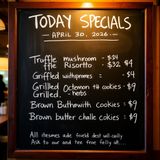
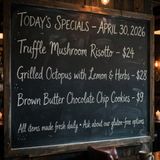
“Handwritten-style chalkboard menu in a cozy café, all text rendered in the exact same realistic chalk handwriting style with natural variations in letter size, slight slant, and chalk texture — no printed or digital fonts anywhere on the board. Title at the top in elegant cursive chalk handwriting: ‘TODAY’S SPECIALS – APRIL 30, 2026’. Below it, three menu items also in the same handwritten chalk style: ‘Truffle Mushroom Risotto – $24’, ‘Grilled Octopus with Lemon & Herbs – $28’, ‘Brown Butter Chocolate Chip Cookies – $9’. At the very bottom, smaller text in the identical handwritten chalk style (slightly smaller but still clearly legible with the same handwriting characteristics): ‘All items made fresh daily • Ask about our gluten-free options’. Warm ambient café lighting, visible chalk dust and smudges, realistic handwriting imperfections, no clean printed text anywhere.”
FP8 quantized variant of Black Forest Labs' FLUX.1 [schnell] model, offering ~2x faster inference with reduced precision while maintaining high-quality image generation in 4 steps
Example outputs coming soon
Details
flux.1-schnell-fp8
Prices shown are in USD
Full pricing detailsProviders & Pricing (1)
FLUX.1 [schnell] FP8 is free to use through Fireworks AI.
fireworks/flux.1-schnell-fp8
Output
Pricing Notes (4)
- • Free to try
- • Normally priced at $0.00035 per inference step
- • FLUX.1 [schnell] uses 4 steps by default, making the effective per-image cost $0.0014
- • FP8 variant uses reduced precision for ~2x faster inference
FLUX.1 [schnell] FP8 API OpenAI-compatible
Developers can generate images using FLUX.1 [schnell] FP8 via Lumenfall's OpenAI-compatible API for 2x faster inference using quantized precision.
https://api.lumenfall.ai/openai/v1
flux.1-schnell-fp8
Code Examples
Text to Image
/v1/images/generationscurl -X POST \ https://api.lumenfall.ai/openai/v1/images/generations \ -H "Authorization: Bearer $LUMENFALL_API_KEY" \ -H "Content-Type: application/json" \ -d '{ "model": "flux.1-schnell-fp8", "prompt": "", "size": "1024x1024" }'# Response:# { "created": 1234567890, "data": [{ "url": "https://...", "revised_prompt": "..." }] }import OpenAI from 'openai';const client = new OpenAI({ apiKey: 'YOUR_API_KEY', baseURL: 'https://api.lumenfall.ai/openai/v1'});const response = await client.images.generate({ model: 'flux.1-schnell-fp8', prompt: '', size: '1024x1024'});// { created: 1234567890, data: [{ url: "https://...", revised_prompt: "..." }] }console.log(response.data[0].url);from openai import OpenAIclient = OpenAI( api_key="YOUR_API_KEY", base_url="https://api.lumenfall.ai/openai/v1")response = client.images.generate( model="flux.1-schnell-fp8", prompt="", size="1024x1024")# { created: 1234567890, data: [{ url: "https://...", revised_prompt: "..." }] }print(response.data[0].url)Parameter Reference
Core Parameters
| Parameter | Type | Description | Modes |
|---|---|---|---|
prompt
|
string | Required. Text prompt for image generation |
T2I
|
seed
|
integer | Random seed for reproducibility |
T2I
|
Size & Layout
| Parameter | Type | Description | Modes |
|---|---|---|---|
size
|
string |
Image dimensions as WxH pixels (e.g. "1024x1024") or aspect ratio (e.g. "16:9")
WxH determines both shape and scale (aspect_ratio and resolution are ignored when size is provided). W:H format is equivalent to aspect_ratio.
|
T2I
|
aspect_ratio
|
string |
Aspect ratio of the output image (e.g. "16:9", "1:1")
Controls shape independently of scale. Use with resolution to control both. If size is also provided, size takes precedence. Any ratio is accepted and mapped to the nearest supported value.
|
T2I
|
resolution
|
string |
Output resolution tier (e.g. "1K", "4K")
1K
Controls scale independently of shape. Higher tiers produce larger images and cost more. If size is also provided, size takes precedence for scale. Any tier is accepted and mapped to the nearest supported value.
|
T2I
|
1K 11 sizes
| Output |
size
|
aspect_ratio
+
resolution
|
|
|---|---|---|---|
| 1183 × 887 | "1183x887" |
or |
"4:3"
+
"1K"
|
| 916 × 1145 | "916x1145" |
or |
"4:5"
+
"1K"
|
| 1145 × 916 | "1145x916" |
or |
"5:4"
+
"1K"
|
| 1024 × 1024 | "1024x1024" |
or |
"1:1"
+
"1K"
|
| 887 × 1182 | "887x1182" |
or |
"3:4"
+
"1K"
|
| 836 × 1254 | "836x1254" |
or |
"2:3"
+
"1K"
|
| 1254 × 836 | "1254x836" |
or |
"3:2"
+
"1K"
|
| 768 × 1365 | "768x1365" |
or |
"9:16"
+
"1K"
|
| 1365 × 768 | "1365x768" |
or |
"16:9"
+
"1K"
|
| 670 × 1564 | "670x1564" |
or |
"9:21"
+
"1K"
|
| 1563 × 670 | "1563x670" |
or |
"21:9"
+
"1K"
|
How these parameters work
size
Exact pixel dimensions
"1920x1080"
aspect_ratio
Shape only, default scale
"16:9"
resolution
Scale tier, preserves shape
"1K"
Priority when combined
size is most specific and always wins. aspect_ratio and resolution control shape and scale independently.
How matching works
7:1 on a model with
4:1 and 8:1,
you get 8:1.
0.5K 1K 2K 4K)
or megapixel tiers (0.25 1).
If the exact tier isn't available, you get the nearest one.
Output & Format
| Parameter | Type | Description | Modes |
|---|---|---|---|
response_format
|
string |
How to return the image
url
b64_json
Default:
"url" |
T2I
|
output_format
|
string |
Output image format
png
jpeg
gif
webp
avif
Gateway converts to requested format if provider doesn't support it natively.
|
T2I
|
output_compression
|
integer | Compression level for lossy formats (JPEG, WebP, AVIF) |
T2I
|
n
|
integer |
Number of images to generate
Default:
1Gateway generates multiple images in parallel even if provider only supports 1.
|
T2I
|
Additional Parameters
Provider-specific passthrough fields, available only when the request is routed to the listed provider.
| Parameter | Type | Description | Modes |
|---|---|---|---|
|
Universal
|
|||
cfg_scale
|
number | Classifier-free guidance scale — higher values stick more closely to the prompt |
T2I
|
|
fireworks
|
|||
num_inference_steps
|
integer | Number of denoising steps for the image generation process. |
T2I
|
Parameter Normalization
How we handle parameters across different providers
Not every provider speaks the same language. When you send a parameter, we handle it in one of four ways depending on what the model supports:
| Behavior | What happens | Example |
|---|---|---|
passthrough |
Sent as-is to the provider | style, quality |
renamed |
Same value, mapped to the field name the provider expects | prompt |
converted |
Transformed to the provider's native format | size |
emulated |
Works even if the provider has no concept of it | n, response_format |
Parameters we don't recognize pass straight through to the upstream API, so provider-specific options still work.
FLUX.1 [schnell] FP8 Benchmarks
FLUX.1 [schnell] FP8 is ranked #55 in Text-to-Image with an Elo of 1186 on the Lumenfall Arena, where real users pick the better image in blind comparisons. These rankings are based on 10 blind-vote competitions.
Text-to-Image Landscape
Elo vs Cost
1 model without pricing omitted.
Elo vs Speed
38 models waiting for enough speed data.
Competition Results
“A glass cube on a wooden table. Inside the cube is a small blue sphere. On top of the cube sits a red book. A green plant is behind the cube, partially visible through the glass. Soft window light from the left.”
“Hyper-photorealistic scene of fluffy baby animals—a golden retriever puppy, tabby kitten, baby bunny, and red fox kit—with big expressive eyes and ultra-detailed soft fur, playfully chasing butterflies and tumbling together in a lush wildflower meadow, warm golden sunrise light with god rays and dew sparkles, joyful wholesome vibe, 8K masterpiece.”
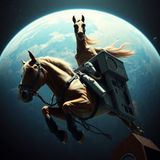
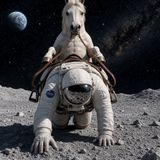
“Horse riding astronaut in space — horse on top, not vice versa. Surreal, highly detailed, cinematic.”
“Modern minimalist restaurant menu design, white background with colorful food photos in grid, sections for appetizers/pizza/mains, bold sans-serif fonts, vibrant accents, clean professional layout for casual dining.”
“Create a clear, 45° top-down isometric miniature 3D cartoon scene of Japan's signature dish: sushi, with soft refined textures, realistic PBR materials, gentle lighting, on a small raised diorama base with minimal garnish and plate. Solid light blue background. At top-center: 'JAPAN' in large bold text, 'SUSHI' below it, small flag icon. Perfectly centered, ultra-clean, high-clarity, square format.”
“Ad for 'Magic Burger'. Dynamic, exploded burger with all components (bun, patty, cheese, lettuce, tomato, sauce) suspended in mid-air. Emphasize photorealistic detail and a sense of motion. Dark, fiery background with glowing embers. Integrate text: 'MAGIC BURGER' as a prominent title, 'LIMITED TIME ONLY' as a secondary message, and '€6.99' in a starburst, all rendered with a fiery, glowing effect.”
“Photorealistic scene inside a yellow New York taxi at night. A capybara is driving, wearing a yellow taxi driver cap and a dark jacket. It has a calm, professional expression and both front paws on the steering wheel. In the back seat sits a human businesswoman in a coat, looking at her phone with a completely normal, bored expression (as if this is just another normal ride). Through the windows you can see the streets of Manhattan at night with blurred lights. Realistic taxi interior, photorealistic, detailed fur and fabric, 35mm lens, night lighting with reflections, shallow depth of field.”
“A glass cube on a wooden table. Inside the cube is a small blue sphere. On top of the cube sits a red book. A green plant is behind the cube, partially visible through the glass. Soft window light from the left.”
“Hyper-photorealistic scene of fluffy baby animals—a golden retriever puppy, tabby kitten, baby bunny, and red fox kit—with big expressive eyes and ultra-detailed soft fur, playfully chasing butterflies and tumbling together in a lush wildflower meadow, warm golden sunrise light with god rays and dew sparkles, joyful wholesome vibe, 8K masterpiece.”
“Horse riding astronaut in space — horse on top, not vice versa. Surreal, highly detailed, cinematic.”
“Modern minimalist restaurant menu design, white background with colorful food photos in grid, sections for appetizers/pizza/mains, bold sans-serif fonts, vibrant accents, clean professional layout for casual dining.”
“Vintage minimalist restaurant logo for "Caffè Florian", retro cloche dome with steam and "Est. 1720" banner, classic typography, warm brown and cream tones, subtle texture on light background, vector emblem style.”
“Create a clear, 45° top-down isometric miniature 3D cartoon scene of Japan's signature dish: sushi, with soft refined textures, realistic PBR materials, gentle lighting, on a small raised diorama base with minimal garnish and plate. Solid light blue background. At top-center: 'JAPAN' in large bold text, 'SUSHI' below it, small flag icon. Perfectly centered, ultra-clean, high-clarity, square format.”
“Vintage gothic Halloween party invitation. Dark parchment poster, spooky border with webs and thorns, central glowing jack-o-lantern, bats, twisted trees, moody night sky. Add elegant gothic title text saying "Halloween Party Invitation", a small scroll banner saying "You are invited to a night of frights", and event details at the bottom: Date: 30.10.2026 Time: 7pm Location: The Arches, NYC Spooky but polished, cinematic lighting, square format.”
“Ad for 'Magic Burger'. Dynamic, exploded burger with all components (bun, patty, cheese, lettuce, tomato, sauce) suspended in mid-air. Emphasize photorealistic detail and a sense of motion. Dark, fiery background with glowing embers. Integrate text: 'MAGIC BURGER' as a prominent title, 'LIMITED TIME ONLY' as a secondary message, and '€6.99' in a starburst, all rendered with a fiery, glowing effect.”
“Photorealistic scene inside a yellow New York taxi at night. A capybara is driving, wearing a yellow taxi driver cap and a dark jacket. It has a calm, professional expression and both front paws on the steering wheel. In the back seat sits a human businesswoman in a coat, looking at her phone with a completely normal, bored expression (as if this is just another normal ride). Through the windows you can see the streets of Manhattan at night with blurred lights. Realistic taxi interior, photorealistic, detailed fur and fabric, 35mm lens, night lighting with reflections, shallow depth of field.”
“Horse riding astronaut in space — horse on top, not vice versa. Surreal, highly detailed, cinematic.”
“Vintage minimalist restaurant logo for "Caffè Florian", retro cloche dome with steam and "Est. 1720" banner, classic typography, warm brown and cream tones, subtle texture on light background, vector emblem style.”
“Create a clear, 45° top-down isometric miniature 3D cartoon scene of Japan's signature dish: sushi, with soft refined textures, realistic PBR materials, gentle lighting, on a small raised diorama base with minimal garnish and plate. Solid light blue background. At top-center: 'JAPAN' in large bold text, 'SUSHI' below it, small flag icon. Perfectly centered, ultra-clean, high-clarity, square format.”
“Vintage gothic Halloween party invitation. Dark parchment poster, spooky border with webs and thorns, central glowing jack-o-lantern, bats, twisted trees, moody night sky. Add elegant gothic title text saying "Halloween Party Invitation", a small scroll banner saying "You are invited to a night of frights", and event details at the bottom: Date: 30.10.2026 Time: 7pm Location: The Arches, NYC Spooky but polished, cinematic lighting, square format.”
“Handwritten-style chalkboard menu in a cozy café, all text rendered in the exact same realistic chalk handwriting style with natural variations in letter size, slight slant, and chalk texture — no printed or digital fonts anywhere on the board. Title at the top in elegant cursive chalk handwriting: ‘TODAY’S SPECIALS – APRIL 30, 2026’. Below it, three menu items also in the same handwritten chalk style: ‘Truffle Mushroom Risotto – $24’, ‘Grilled Octopus with Lemon & Herbs – $28’, ‘Brown Butter Chocolate Chip Cookies – $9’. At the very bottom, smaller text in the identical handwritten chalk style (slightly smaller but still clearly legible with the same handwriting characteristics): ‘All items made fresh daily • Ask about our gluten-free options’. Warm ambient café lighting, visible chalk dust and smudges, realistic handwriting imperfections, no clean printed text anywhere.”
“A glass cube on a wooden table. Inside the cube is a small blue sphere. On top of the cube sits a red book. A green plant is behind the cube, partially visible through the glass. Soft window light from the left.”
“Hyper-photorealistic scene of fluffy baby animals—a golden retriever puppy, tabby kitten, baby bunny, and red fox kit—with big expressive eyes and ultra-detailed soft fur, playfully chasing butterflies and tumbling together in a lush wildflower meadow, warm golden sunrise light with god rays and dew sparkles, joyful wholesome vibe, 8K masterpiece.”
“Horse riding astronaut in space — horse on top, not vice versa. Surreal, highly detailed, cinematic.”
“Ad for 'Magic Burger'. Dynamic, exploded burger with all components (bun, patty, cheese, lettuce, tomato, sauce) suspended in mid-air. Emphasize photorealistic detail and a sense of motion. Dark, fiery background with glowing embers. Integrate text: 'MAGIC BURGER' as a prominent title, 'LIMITED TIME ONLY' as a secondary message, and '€6.99' in a starburst, all rendered with a fiery, glowing effect.”
“Photorealistic scene inside a yellow New York taxi at night. A capybara is driving, wearing a yellow taxi driver cap and a dark jacket. It has a calm, professional expression and both front paws on the steering wheel. In the back seat sits a human businesswoman in a coat, looking at her phone with a completely normal, bored expression (as if this is just another normal ride). Through the windows you can see the streets of Manhattan at night with blurred lights. Realistic taxi interior, photorealistic, detailed fur and fabric, 35mm lens, night lighting with reflections, shallow depth of field.”
“Handwritten-style chalkboard menu in a cozy café, all text rendered in the exact same realistic chalk handwriting style with natural variations in letter size, slight slant, and chalk texture — no printed or digital fonts anywhere on the board. Title at the top in elegant cursive chalk handwriting: ‘TODAY’S SPECIALS – APRIL 30, 2026’. Below it, three menu items also in the same handwritten chalk style: ‘Truffle Mushroom Risotto – $24’, ‘Grilled Octopus with Lemon & Herbs – $28’, ‘Brown Butter Chocolate Chip Cookies – $9’. At the very bottom, smaller text in the identical handwritten chalk style (slightly smaller but still clearly legible with the same handwriting characteristics): ‘All items made fresh daily • Ask about our gluten-free options’. Warm ambient café lighting, visible chalk dust and smudges, realistic handwriting imperfections, no clean printed text anywhere.”
“Modern minimalist restaurant menu design, white background with colorful food photos in grid, sections for appetizers/pizza/mains, bold sans-serif fonts, vibrant accents, clean professional layout for casual dining.”
“Vintage minimalist restaurant logo for "Caffè Florian", retro cloche dome with steam and "Est. 1720" banner, classic typography, warm brown and cream tones, subtle texture on light background, vector emblem style.”
“Create a clear, 45° top-down isometric miniature 3D cartoon scene of Japan's signature dish: sushi, with soft refined textures, realistic PBR materials, gentle lighting, on a small raised diorama base with minimal garnish and plate. Solid light blue background. At top-center: 'JAPAN' in large bold text, 'SUSHI' below it, small flag icon. Perfectly centered, ultra-clean, high-clarity, square format.”
“Vintage gothic Halloween party invitation. Dark parchment poster, spooky border with webs and thorns, central glowing jack-o-lantern, bats, twisted trees, moody night sky. Add elegant gothic title text saying "Halloween Party Invitation", a small scroll banner saying "You are invited to a night of frights", and event details at the bottom: Date: 30.10.2026 Time: 7pm Location: The Arches, NYC Spooky but polished, cinematic lighting, square format.”
“Ad for 'Magic Burger'. Dynamic, exploded burger with all components (bun, patty, cheese, lettuce, tomato, sauce) suspended in mid-air. Emphasize photorealistic detail and a sense of motion. Dark, fiery background with glowing embers. Integrate text: 'MAGIC BURGER' as a prominent title, 'LIMITED TIME ONLY' as a secondary message, and '€6.99' in a starburst, all rendered with a fiery, glowing effect.”
“Horse riding astronaut in space — horse on top, not vice versa. Surreal, highly detailed, cinematic.”
“Vintage gothic Halloween party invitation. Dark parchment poster, spooky border with webs and thorns, central glowing jack-o-lantern, bats, twisted trees, moody night sky. Add elegant gothic title text saying "Halloween Party Invitation", a small scroll banner saying "You are invited to a night of frights", and event details at the bottom: Date: 30.10.2026 Time: 7pm Location: The Arches, NYC Spooky but polished, cinematic lighting, square format.”
“Handwritten-style chalkboard menu in a cozy café, all text rendered in the exact same realistic chalk handwriting style with natural variations in letter size, slight slant, and chalk texture — no printed or digital fonts anywhere on the board. Title at the top in elegant cursive chalk handwriting: ‘TODAY’S SPECIALS – APRIL 30, 2026’. Below it, three menu items also in the same handwritten chalk style: ‘Truffle Mushroom Risotto – $24’, ‘Grilled Octopus with Lemon & Herbs – $28’, ‘Brown Butter Chocolate Chip Cookies – $9’. At the very bottom, smaller text in the identical handwritten chalk style (slightly smaller but still clearly legible with the same handwriting characteristics): ‘All items made fresh daily • Ask about our gluten-free options’. Warm ambient café lighting, visible chalk dust and smudges, realistic handwriting imperfections, no clean printed text anywhere.”
“Modern minimalist restaurant menu design, white background with colorful food photos in grid, sections for appetizers/pizza/mains, bold sans-serif fonts, vibrant accents, clean professional layout for casual dining.”
“Vintage minimalist restaurant logo for "Caffè Florian", retro cloche dome with steam and "Est. 1720" banner, classic typography, warm brown and cream tones, subtle texture on light background, vector emblem style.”
“Vintage gothic Halloween party invitation. Dark parchment poster, spooky border with webs and thorns, central glowing jack-o-lantern, bats, twisted trees, moody night sky. Add elegant gothic title text saying "Halloween Party Invitation", a small scroll banner saying "You are invited to a night of frights", and event details at the bottom: Date: 30.10.2026 Time: 7pm Location: The Arches, NYC Spooky but polished, cinematic lighting, square format.”
“Ad for 'Magic Burger'. Dynamic, exploded burger with all components (bun, patty, cheese, lettuce, tomato, sauce) suspended in mid-air. Emphasize photorealistic detail and a sense of motion. Dark, fiery background with glowing embers. Integrate text: 'MAGIC BURGER' as a prominent title, 'LIMITED TIME ONLY' as a secondary message, and '€6.99' in a starburst, all rendered with a fiery, glowing effect.”
“A glass cube on a wooden table. Inside the cube is a small blue sphere. On top of the cube sits a red book. A green plant is behind the cube, partially visible through the glass. Soft window light from the left.”
“Create a clear, 45° top-down isometric miniature 3D cartoon scene of Japan's signature dish: sushi, with soft refined textures, realistic PBR materials, gentle lighting, on a small raised diorama base with minimal garnish and plate. Solid light blue background. At top-center: 'JAPAN' in large bold text, 'SUSHI' below it, small flag icon. Perfectly centered, ultra-clean, high-clarity, square format.”
Top Matchups
See how FLUX.1 [schnell] FP8 performs head-to-head against other AI models, ranked by community votes in blind comparisons.
Use Cases
See all Use Cases![FLUX.1 [schnell] FP8 — Photorealism](https://assets.lumenfall.ai/L45m4TQauuXFJyqvF6VI3wDg-FAoboUx_qMRfSJ0JPE/rs:fill:400:300:1/plain/gs://lumenfall-prod-assets/ywr2xfqwr91lcxm1diwfujirzox9@jpeg)
![FLUX.1 [schnell] FP8 — Creativity](https://assets.lumenfall.ai/weSt0p1vB2moiQ-k0TK7kxUjvg6bUqJURFgng7xtLHs/rs:fill:400:300:1/plain/gs://lumenfall-prod-assets/a2zxzx9wfh2utfujphfqle36unxw@jpeg)
![FLUX.1 [schnell] FP8 — Art](https://assets.lumenfall.ai/gwzzfpIaRjTXjEfjGCIRTmxDRgyF2Kd7QV9g6ZoOWww/rs:fill:400:300:1/plain/gs://lumenfall-prod-assets/zdhd10a5269ue3jne6tna6m1eu29@jpeg)
![FLUX.1 [schnell] FP8 — Product, Branding & Commercial](https://assets.lumenfall.ai/TsFbEFEdZeJ9s3VnEsVRHzjqNqt7Y3zkO5NDWsez9xM/rs:fill:400:300:1/plain/gs://lumenfall-prod-assets/tknrjsj0cadm3hlcl7qea3keblz8@jpeg)
Gallery
View all 11 imagesFLUX.1 [schnell] FP8 FAQ
How much does FLUX.1 [schnell] FP8 cost?
FLUX.1 [schnell] FP8 is free to use through Lumenfall's unified API.
How do I use FLUX.1 [schnell] FP8 via API?
You can use FLUX.1 [schnell] FP8 through Lumenfall's OpenAI-compatible API. Send requests to the unified endpoint with model ID "flux.1-schnell-fp8". Code examples are available in Python, JavaScript, and cURL.
Which providers offer FLUX.1 [schnell] FP8?
FLUX.1 [schnell] FP8 is available through Fireworks AI on Lumenfall. Lumenfall automatically routes requests to the best available provider.
What is the maximum resolution for FLUX.1 [schnell] FP8?
FLUX.1 [schnell] FP8 supports images up to 1024x1024 resolution.
Overview
FLUX.1 [schnell] FP8 is a quantized version of Black Forest Labs’ distilled text-to-image model, optimized for maximum inference speed. By utilizing 8-bit floating-point precision, this variant achieves significantly lower latency and reduced memory overhead compared to the standard model. It is specifically designed for high-throughput applications where generating competitive imagery in a handful of steps is the primary requirement.
Strengths
- Generation Speed: Produces usable 1024x1024 images in just 1 to 4 sampling steps, making it one of the fastest high-resolution open-weight models available.
- Standardized Resource Efficiency: The FP8 quantization reduces the VRAM footprint and computational load, allowing for roughly 2x faster inference times compared to the full-precision version without a proportional loss in visual quality.
- Prompt Adherence: Despite the lowered precision and distillation, the model retains the architectural ability to follow complex descriptive prompts and render legible, coherent text within images.
- Output Consistency: It maintains the structural integrity and composition characteristic of the FLUX.1 family, even at extremely low step counts.
Limitations
- Artistic Nuance: Due to the distillation and quantization, it offers less stylistic flexibility and fine-grained detail compared to the [dev] or [pro] iterations of FLUX.1.
- Precision Loss: FP8 quantization can occasionally lead to minor artifacts or less smooth gradients in complex lighting scenarios that would be better handled by 16-bit or 32-bit models.
- Step Sensitivity: The model is strictly tuned for low-step counts; increasing the sampling steps beyond the recommended range usually yields diminishing returns or visual regressions.
Technical Background
FLUX.1 [schnell] is a latent diffusion model based on a flow-based transformer architecture. This specific FP8 variant applies post-training quantization to the model weights, mapping them to 8-bit precision to optimize throughput on modern hardware. The “schnell” version itself is the result of a performance-oriented distillation process, allowing the model to reach a converged image state in a fraction of the time required by standard diffusion processes.
Best For
This model is ideal for real-time applications, rapid prototyping, and high-volume image generation workflows where operational cost and latency are critical. It is a strong choice for “generate-as-you-type” interfaces or large-scale content pipelines that require decent photorealism at minimal compute expense. FLUX.1 [schnell] FP8 is available for testing and integration through Lumenfall’s unified API and interactive playground.
Try FLUX.1 [schnell] FP8 in Playground
Generate images with custom prompts — no API key needed.